Loading areas must move goods between a warehouse and vehicles that do not always stop at the same height. Two equipment types are often considered: dock levelers and loading-dock lifts. They solve related problems in different ways, so choosing the correct mechanism is the first step toward a safer, more efficient bay.
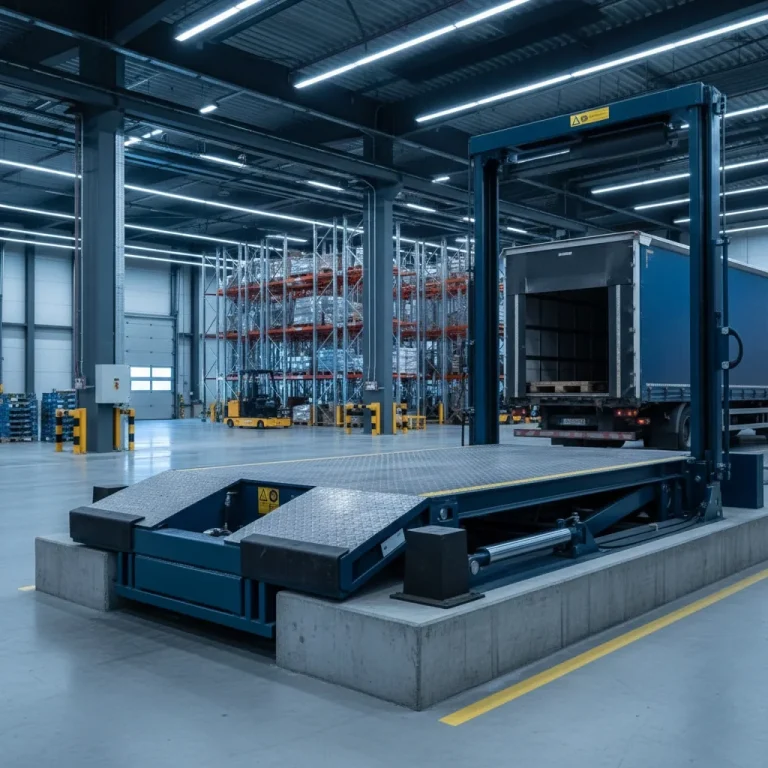
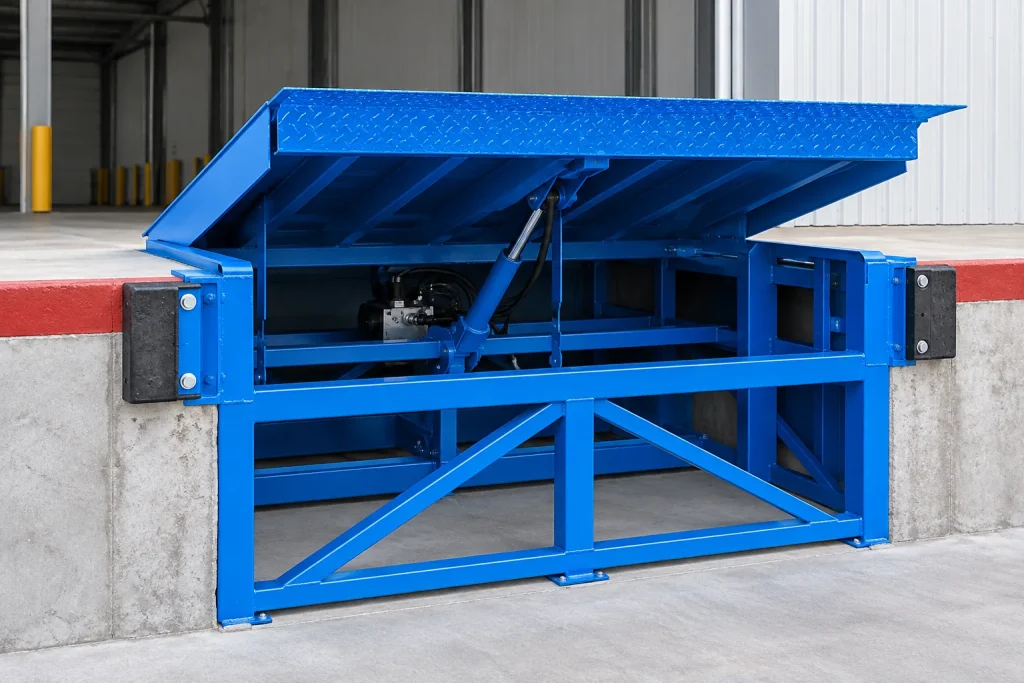
The featured image shows a pit-mounted hydraulic dock leveler. Its hinged deck pivots and extends a lip onto the vehicle bed. A loading-dock lift, by comparison, raises and lowers a complete platform vertically and can serve a wider height difference where a simple bridge is unsuitable.
Dock leveler or loading-dock lift?
Choose from the movement required rather than the product name. A dock leveler is normally used where the building dock and vehicle are already at broadly similar heights. It compensates for the remaining difference and creates a short crossing route.
A vertical dock lift may be more appropriate when goods must travel between ground level and dock level, when there is no raised dock, or when the height difference falls outside a practical leveler range. It may also handle carts, pallet trucks or other loads where a vertical transfer supports the workflow.
- Dock leveler: pivots around the dock, bridges to a vehicle and supports through traffic across the deck.
- Loading-dock lift: moves the load platform vertically between defined working heights.
- Combined layout: some facilities use different equipment at different bays to serve their vehicle mix.
Define the load and traffic
For either solution, provide the maximum combined load and explain how it moves. A forklift creates concentrated wheel loads and dynamic forces, while a hand pallet truck has smaller wheels that are sensitive to gaps and gradients. Load footprint, turning space and approach direction influence platform dimensions and edge protection.
Record vehicle types, deck heights, suspension movement and daily bay usage. If the site handles vans, rigid trucks and trailers, the full range may lead to more than one bay configuration.
Review the building interface
A pit-mounted system relies on accurate civil work. Confirm pit length, width and depth, concrete condition, embedded items, dock-face construction, bumpers, drainage and access for installation. A vertical dock lift additionally needs space for the full platform travel and a safe way to protect exposed edges at every position.
Where excavation is difficult, ask whether a surface-mounted arrangement is practical. The supplier should show the ramp, clearances and traffic route on the approval drawing so the buyer can assess the space before production.
Coordinate vehicle and edge safety
Unexpected vehicle departure is a serious loading-bay hazard. The operating procedure should define how the vehicle is positioned, secured and released. Depending on the site, this may involve wheel chocks, restraints, traffic lights or another controlled communication system.
Open dock edges and moving platforms also need attention. Barriers, gates, guardrails, wheel stops and interlocks may be required according to the equipment and risk assessment. Operators should have a clear view of the transfer area and know when it is safe to cross.
Consider the hydraulic and control system
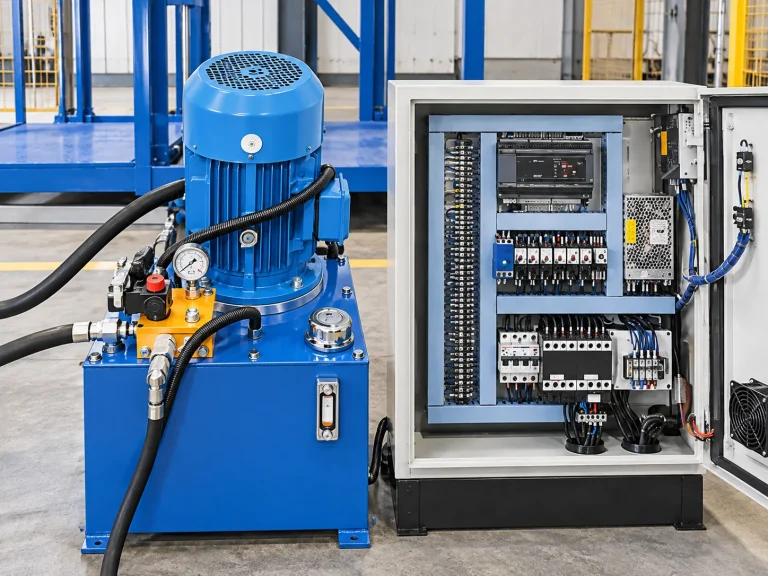
The power unit, cylinders, hoses, valves and controls must suit the load and frequency of use. Ask how descent is controlled, how overload and hose-related risks are addressed, and how the equipment can be lowered during an approved emergency procedure. Electrical interfaces, travel limits and gate signals should be documented.
Safety devices are not substitutes for correct operating procedures. The final arrangement needs both engineered safeguards and trained users.
Design for the local environment
Rain, coastal air, cold rooms, dust and wash-down can change the finish, electrical enclosure, drainage and maintenance needs. A sheltered warehouse bay differs from an outdoor yard installation. Describe the real environment and cleaning method rather than simply requesting an “outdoor model.”
Measure performance after installation
Useful operating measures include vehicle turnaround time, loading interruptions, manual repositioning, damage incidents and maintenance downtime. These observations help the facility improve traffic rules and decide whether other bays need the same solution.
Information required for selection
- Warehouse dock height and all vehicle deck heights
- Maximum load, handling equipment and wheel data
- Required platform size and height range
- Existing pit or available installation space
- Daily cycles, shift pattern and desired workflow
- Indoor or outdoor exposure and drainage conditions
- Power supply, destination and site drawings or photos
Frequently asked questions
Can a dock leveler lift goods from the yard to dock level?
A conventional dock leveler is intended to bridge a limited height difference at the dock. A vertical dock lift may be more suitable when the whole load must travel through a larger vertical distance.
Can the same equipment serve forklifts and pallet trucks?
Possibly, but wheel loads, tyre or wheel size, gradients, clearances and platform dimensions must be checked for both.
What is the first information a supplier needs?
Start with vehicle and dock heights, the complete moving load, handling method, available space and clear site photos. These facts determine which equipment type should be considered.
Unsure whether your site needs a dock leveler or a vertical dock lift? Send Hongli the bay dimensions, vehicle heights and load details for a technical discussion.