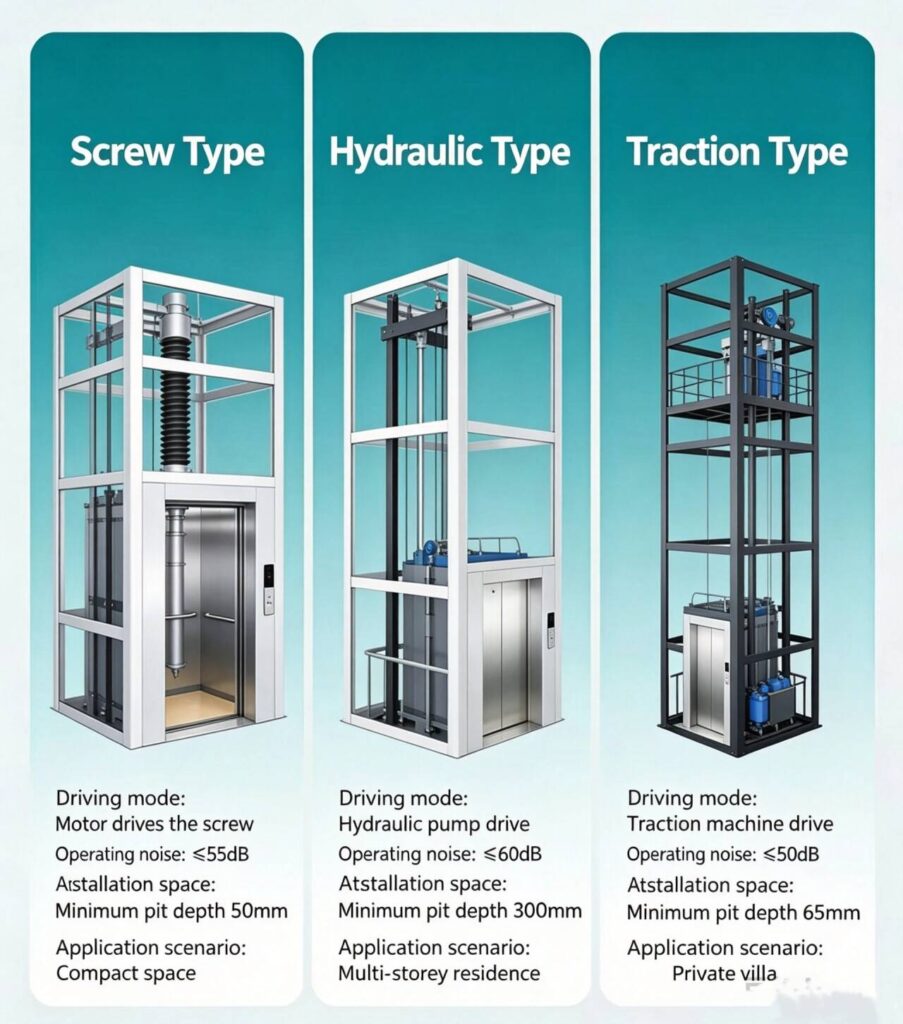
Comparing screw, hydraulic and traction lifts starts with the job the equipment must perform. A residential passenger lift, an accessibility platform and an industrial goods lift can have very different operating requirements, even when their enclosures look similar. The illustration introduces three drive concepts; it is a starting point for discussion, not a specification for a particular Hongli product.
About the illustration: the noise figures, pit depths and application labels printed in the image have not been verified for a named model. They are not universal limits or guaranteed Hongli specifications. Use the selected model’s technical documents and approved installation drawings.
Screw drive: check usable space and the operating method
A screw-and-nut drive turns motor rotation into vertical movement through a threaded mechanism. In one common arrangement, the nut travels along a fixed screw. Aritco’s technical explanation describes this arrangement.
For a compact building or renovation, ask the supplier to show the usable platform area, door opening and complete installation footprint on the same drawing. Also confirm the control method, travel limit, maintenance access and lubrication requirements. A small-looking frame does not establish how much usable space remains inside.
Hydraulic drive: assess the whole lifting arrangement
A hydraulic pump sends fluid into a cylinder to produce lifting force; controlled fluid return enables lowering in a conventional arrangement. See Otis’s explanation of hydraulic operation.
For a hydraulic lifting project, discuss the load, platform or cabin dimensions, lifting height and expected trips per hour. Ask where the power unit will sit and how service access, piping and the installation environment will be handled. Do not select a system from lifting force alone: the building layout and operating schedule also need to match the proposed model.
Traction drive: include the shaft layout in the comparison
A traction machine turns a sheave that moves suspension ropes connected to a car and counterweight. Otis’s system overview illustrates the principle.
Request a drawing showing the car, counterweight, drive equipment and maintenance clearances. Compare the specified travel, speed, duty and power requirements with the actual building. The illustration’s “private villa” label does not mean traction equipment is restricted to villas, or that every traction design suits a small shaft.
Compare quotations on the same basis
- Intended use: state whether the project carries people, goods or requires accessibility. A goods-only lift must not be treated as a passenger lift.
- Building space: provide the available shaft dimensions, pit conditions, headroom and openings at every stop.
- Noise: ask for the measurement position, load and operating conditions; figures from different test methods are not a reliable ranking.
- Operating cost: compare expected trips, standby demand, maintenance scope and spare-parts support, rather than motor power alone.
- Project delivery: agree who checks structural suitability, local requirements, installation, commissioning and service arrangements.
Frequently asked questions
Which drive is always the quietest?
There is no reliable universal answer from this image. Compare identified models using equivalent test conditions and consider where the equipment is installed.
Can the illustrated pit depths be used for construction?
No. Civil works should follow the selected equipment’s approved project drawings, with the actual site conditions checked first.
What information helps obtain a useful quotation?
Send the intended use, destination country, load, required usable space, travel height, number of stops, power supply and site photographs. Include expected daily use and any access restrictions.
Planning a hydraulic lifting project? Explore Hongli’s hydraulic lifting equipment and send your project requirements. Available configurations and final performance must be confirmed in the quotation and technical documents.