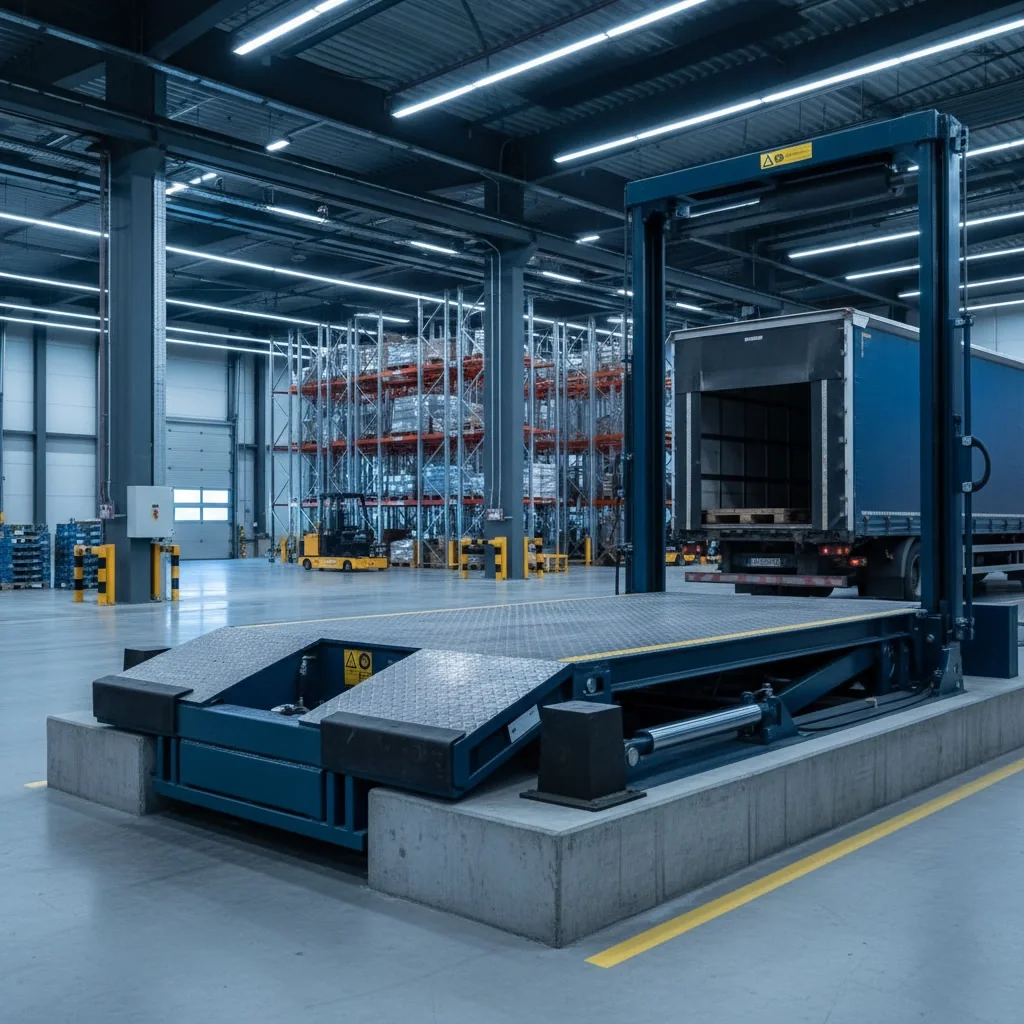
Every truck that arrives at a warehouse brings a slightly different deck height. Suspension movement, vehicle loading and the position of the dock all change the gap between the building and the trailer. A hydraulic dock leveler creates an adjustable bridge across that gap so forklifts and pallet trucks can transfer goods with a smoother, more predictable route.
The featured image shows a pit-mounted hydraulic dock leveler serving a warehouse loading bay. The deck rises, the hinged lip extends toward the vehicle and the platform lowers until the lip is supported by the truck bed. Although the principle is simple, reliable performance depends on matching the equipment, building and daily operating process.
Begin with the vehicles and handling equipment
A dock leveler should be selected from actual operating data rather than a single headline capacity. Start by recording the lowest and highest vehicle deck heights, the warehouse dock height, the forklift type and the heaviest combination of forklift, operator and cargo expected to cross the platform.
Wheel loads and traffic frequency matter because a moving forklift transfers concentrated forces into the deck. Platform width, lip length and the working gradient also affect how comfortably long-wheelbase or low-clearance equipment can cross. If different vehicle types use the same bay, share the full range with the supplier.
Specify the platform and pit as one system
For a new facility, the pit can be designed around the selected leveler. For an existing warehouse, the equipment must fit the available pit or the civil structure must be modified. Useful site information includes pit length, width and depth, dock-face construction, bumper position, drainage, electrical supply and clear photos from several angles.
- Rated capacity: based on the real moving load and operating conditions, with the required design margin confirmed by the supplier.
- Deck and lip: sized for vehicle access, tyre path and sufficient contact with the truck bed.
- Working range: checked against the lowest and highest vehicle positions likely to use the bay.
- Surface and finish: selected for traction, cleaning needs, humidity and corrosion exposure.
- Power and controls: located where operators can see the loading area while keeping clear of vehicle movement.
Build safety into the bay layout
The leveler is only one part of loading-bay safety. Dock bumpers help protect the structure, while wheel chocks or a suitable vehicle-restraint procedure reduce the risk of a truck moving before loading is complete. Clear signals between the driver and warehouse team should define when a vehicle is secured and when it may leave.
Depending on the project, equipment safeguards may include an emergency stop, maintenance support, toe protection, controlled descent and a method of preventing unintended operation. Guardrails or barriers may also be needed where an open edge is exposed. Final measures must follow the site risk assessment and applicable local requirements.
Plan for throughput, not only installation
A well-planned bay lets the operator position the leveler without repeated manual adjustment. The approach lane should remain clear, the controls should be easy to reach and the forklift should have enough turning space on both sides of the transition. Warehouse managers can compare vehicle turnaround time, interruptions and near-miss reports before and after installation to understand the operational effect.
Cold stores, food facilities and coastal sites need extra attention to seals, moisture, wash-down practices and corrosion protection. Outdoor or partially exposed bays also need drainage that prevents water from collecting in the pit.
Inspection and maintenance priorities
Operators should complete a short visual check before use and report unusual noise, leakage, damaged hinges or irregular movement. Planned maintenance normally includes the deck structure, hinges, lip mechanism, hydraulic components, hoses, electrical controls, fixing points and safety devices. The platform must be mechanically supported and isolated before anyone enters the pit; service work should only be completed by trained personnel.
Information to include in your enquiry
For a useful technical proposal, send the required capacity, forklift and cargo details, daily cycle estimate, dock and vehicle heights, pit dimensions, platform width preference, electrical supply, environmental conditions and site photos. Mention whether the project is a new building or a replacement because the installation approach can be very different.
Frequently asked questions
Can one dock leveler serve several truck heights?
Yes, within its designed working range. The actual range must be checked against the site dock height, vehicle deck heights, lip contact and acceptable crossing gradient.
Is the highest capacity always the best choice?
No. Capacity is only one part of the specification. Deck dimensions, concentrated wheel loads, traffic frequency, installation conditions and safeguards should be evaluated together.
What should be confirmed before production?
Approve the general arrangement drawing, pit dimensions, working range, capacity, lip design, control method, finish, electrical data, safety options and the responsibilities for civil and electrical work.
Planning a new loading bay or replacing an existing unit? Send Hongli your vehicle, load and site information so our team can discuss a suitable configuration.